Advanced shaders · lesson 1 of 19 · Advanced · about 5 min
Ocean 1: a surface made of waves
You will build: Write waveH(): the sum of five moving sine waves. Show it from above as a color map.
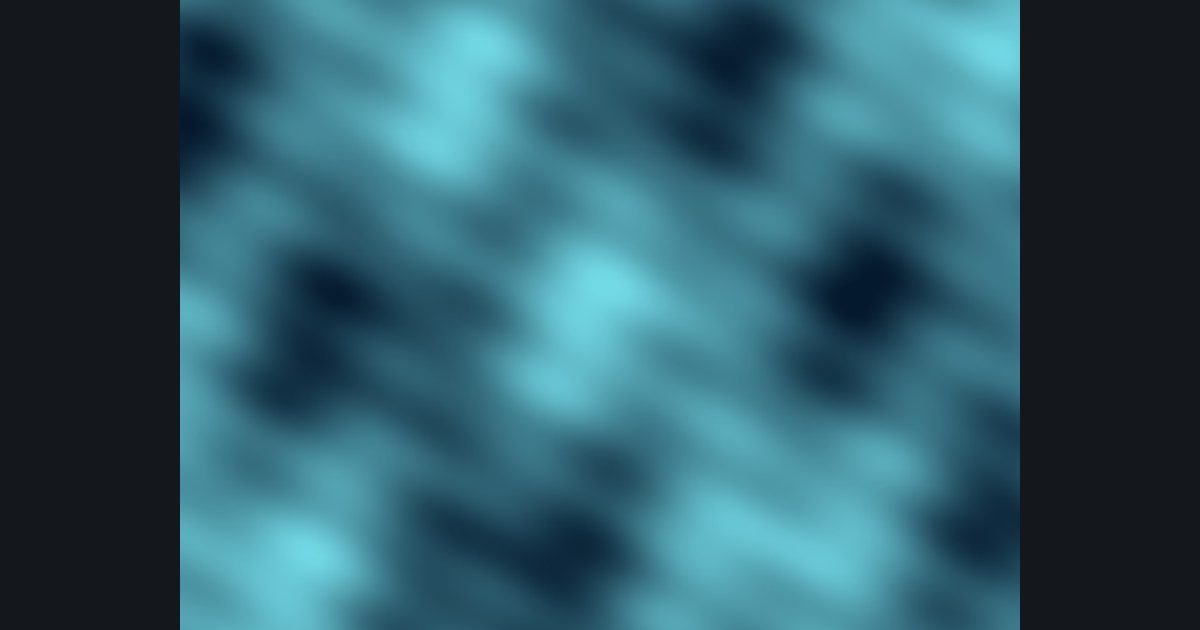
Every game ocean starts with the same idea: the water is a height field. For every spot (x, z) on the sea there is one number, the height h of the surface there. Animate that number and the sea moves.
The simplest wave is a sine: sin(position * frequency + time * speed). The position has to be measured along the direction the wave travels, and that is exactly what a dot product gives you: dot(xz, direction).
One sine looks like a corrugated roof. The trick that makes it look like water is to add several, each with its own direction, frequency, speed and a smaller amplitude: long slow swells with short fast ripples riding on them.
float waveH(float2 xz)
{
    float h = 0.0;
    h += 0.30 * sin(dot(xz, float2(0.80, 0.60)) * 0.9 + time * 1.1);
    h += 0.20 * sin(dot(xz, float2(-0.60, 0.80)) * 1.4 + time * 1.3);
    // ...three more, smaller and faster
    return h * 0.5;
}
Here you draw the height field seen from above, as a map: dark where the water is low, bright where it is high. Next lesson you stand in it.
The numbers you need
Everything the picture depends on is given, so the challenge is the code, not guessing.
- Waves (amplitude, direction, frequency, speed)
0.30, (0.80, 0.60), 0.9, 1.1 | 0.20, (-0.60, 0.80), 1.4, 1.3 | 0.12, (0.95, -0.30), 2.3, 1.8 | 0.07, (-0.20, -0.98), 3.7, 2.4 | 0.04, (0.55, 0.83), 6.1, 3.1- Each wave
amplitude * sin(dot(xz, direction) * frequency + time * speed)- Result
h = sum of the waves * 0.5- Position
p = (uv - 0.5) * float2(aspect, 1.0) * 10.0- Color
lerp(float3(0.02, 0.1, 0.18), float3(0.45, 0.85, 0.9), saturate(h * 1.6 + 0.5))
Try it in your own language
The lesson is written once and shown in every language. Pick yours: Unity (Built-in), Unity (URP), Unreal, Shadertoy / WebGL, OpenGL (LWJGL, raylib), three.js, GameMaker, LÖVE (Lua), Godot, Apple (iOS, macOS), WebGPU / Bevy.
Start codingGo deeper
Part of the learning path: Realistic water and sky.