Hard EffectsAnimated
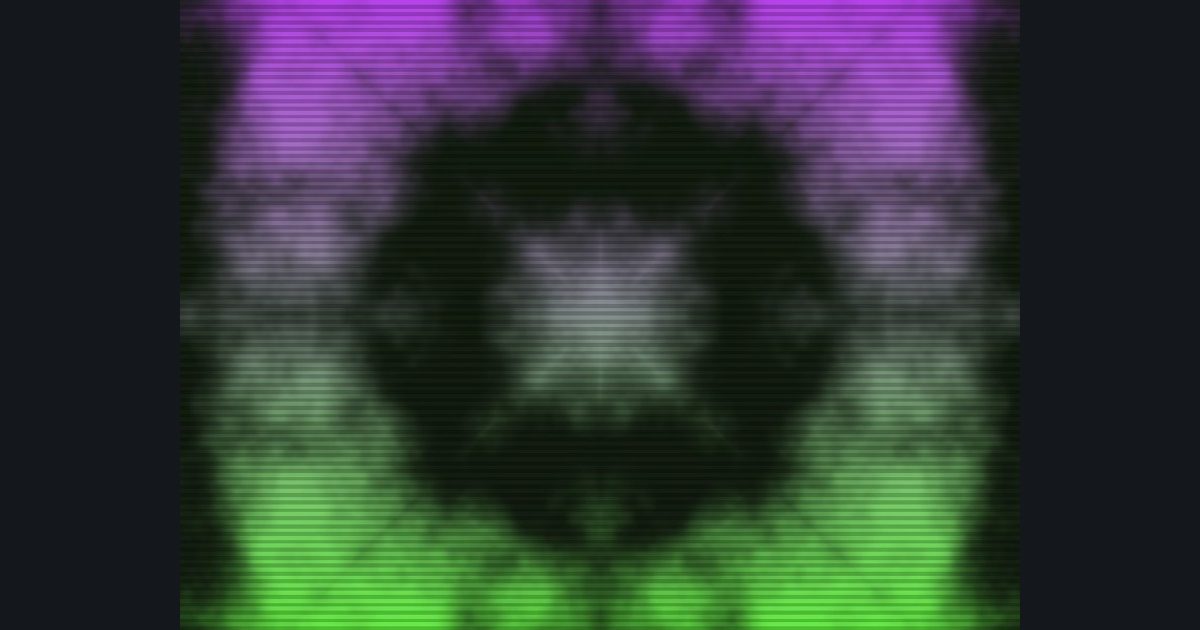
4-way kaleidoscope of fractal noise, spinning with scanlines
A picture built in steps: kaleidoscope, then spin, then draw fractal noise, then color it, then finish with scanlines. Every step is listed below with its exact numbers.
How this challenge works
You write a fragment shader that draws the picture above, live in your browser. A match bar shows how close you are, and the score combines accuracy, code size (the par is 1153 characters in Unity (Built-in)) and GPU speed. Work in HLSL, GLSL, WGSL, Metal or Godot and export the result when you are done.
The numbers you need
- Space
p = (uv - 0.5) * float2(aspect, 1.0)- Step 1: Kaleidoscope
a = atan2(p.y, p.x); a = abs(fmod(a + 6.2831853, 1.571) - 0.785); p = length(p) * float2(cos(a), sin(a)) (4 mirrored wedges)- Step 2: Spin
turn p by time * -0.5 radians: c = cos(angle), s = sin(angle), p = float2(c * p.x + s * p.y, -s * p.x + c * p.y)- Step 3: Pattern
m = smoothstep(0.25, 0.75, fbm(p * 4.5 + float2(1.0, 2.0)))- Step 4: Colors
lerp(float3(0.07, 0.11, 0.06), lerp(float3(0.39, 0.93, 0.26), float3(0.72, 0.26, 0.93), uv.y), m)- Step 5: Finish
col *= 0.8 + 0.2 * step(0.5, frac(uv.y * 80.0))
Helper functions provided
The toolbox has: hash(), vnoise(), fbm(). Add them above your frag function with one click.
Solve it in your language
Unity (Built-in), Unity (URP), Unreal, Shadertoy / WebGL, OpenGL (LWJGL, raylib), three.js, GameMaker, LÖVE (Lua), Godot, Apple (iOS, macOS), WebGPU / Bevy.
Start coding